The Crown Never Asked Permission: Jean Michel Basquiat, the Rise of a Beautiful Disruption
Jean Michel Basquiat did not enter the art world quietly. He arrived like a signal from the street, from history, from Brooklyn, from Black genius, from jazz, from rage, from poetry, from everything polite society had tried not to see. In less than a decade, he transformed from downtown outsider into one of the most consequential artists of the twentieth century. His paintings still speak in crowns, wounds, codes, saints, boxers, skulls, prophets, and warnings.
The Crown Never Asked Permission
Before Jean Michel Basquiat became a market force, a museum subject, a fashion reference, a cultural symbol, and a name that could send an auction room into a fever, he was a young man moving through New York with the urgency of someone who knew time was not promised.
Born in Brooklyn in 1960, Basquiat came of age in a city that was broke, electric, dangerous, and alive with invention. New York in the late 1970s and early 1980s was not yet the polished real estate theater it would become. It was raw material. Subway cars, nightclubs, abandoned buildings, downtown galleries, punk venues, hip hop, graffiti, jazz memory, Caribbean lineage, Black history, and street level mythology all collided into one charged atmosphere.
Basquiat did not simply witness that world. He absorbed it. Then he translated it.
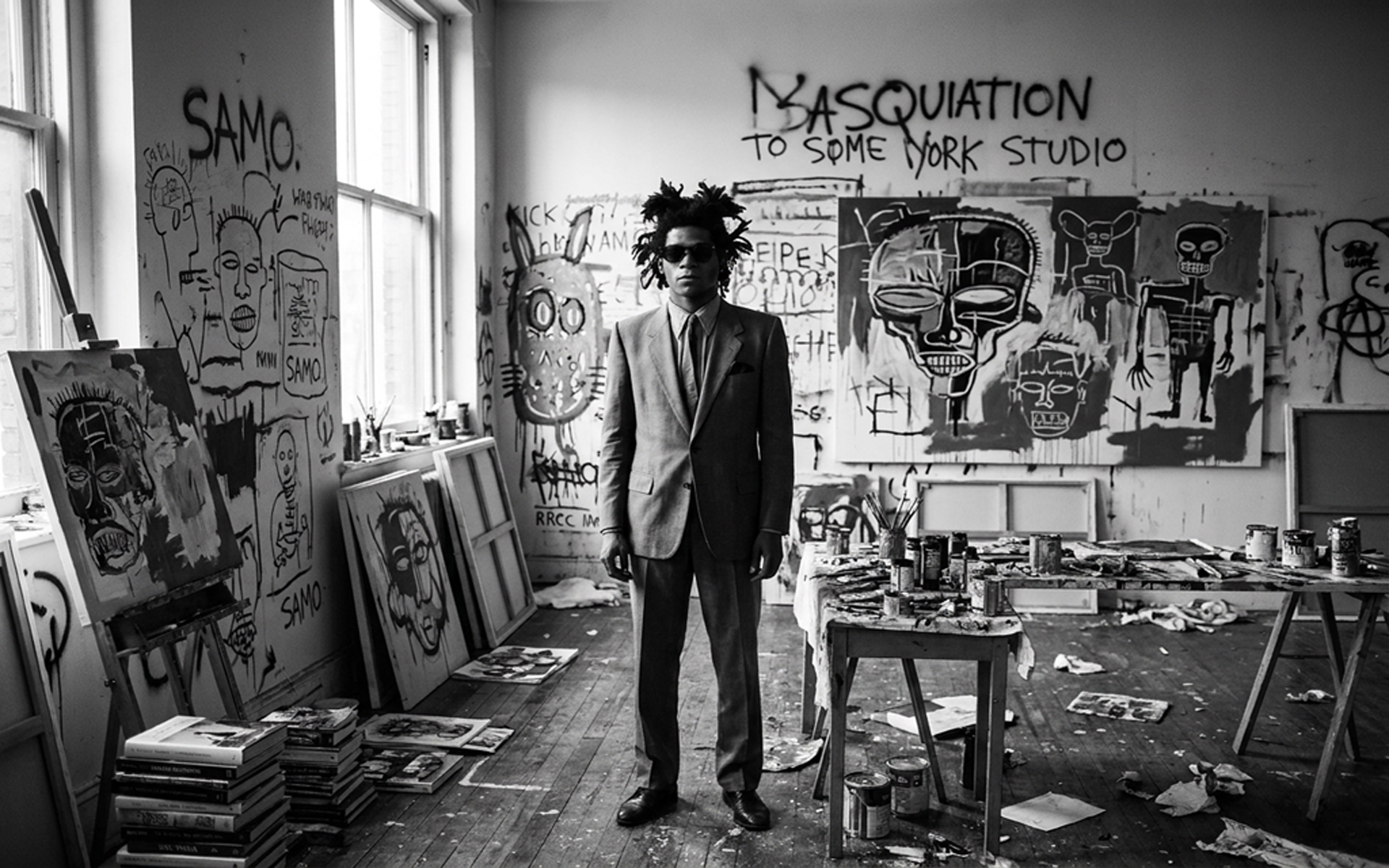
His early public identity came through SAMO, the graffiti project he created with Al Diaz. The work appeared across lower Manhattan as cryptic, philosophical, poetic fragments. It was not graffiti as decoration. It was commentary. It was attitude. It was branding before branding. It was street literature with a blade in it.
By the early 1980s, Basquiat had moved from the street into the gallery system, but he never truly left the street behind. That tension became part of his power. He entered the white cube carrying the electricity of the sidewalk.
The art world loves the story of discovery. Basquiat complicates that story. He was not discovered like a found object. He made himself impossible to ignore.
The Rise
Basquiat’s rise was astonishing not only because it happened quickly, but because it happened against the architecture of exclusion.
He was young. He was Black. He was self fashioned. He came from downtown energy, not academic permission. He understood art history, but he refused to behave like a guest inside it.
His paintings carried anatomy, jazz, boxing, police violence, colonial history, corporate logos, spiritual symbols, cartoons, kings, warriors, saints, and broken language. They looked spontaneous, but they were deeply intelligent. They were not chaotic because he lacked control. They were chaotic because the world he was describing was chaotic.
Museums now describe Basquiat’s art as a fusion of text, image, abstraction, figuration, historical information, and contemporary critique. The Whitney notes that his work engaged dichotomies such as wealth and poverty, integration and segregation, inner and outer experience, while using social commentary to attack racism and power structures.
That is the key to understanding him. Basquiat was never just making marks. He was making arguments.
He understood the body as a battlefield. He understood the crown as both honor and burden. He understood that Black brilliance is often celebrated only after being wounded, consumed, or mythologized.
His figures often feel like they are glowing and decaying at once. Skulls become portraits. Words become scars. Crowns become indictments. The canvas becomes a place where beauty and violence cannot be separated.
The Style Was the Strategy
Basquiat’s art is often described as raw, but that word can be too easy. Raw can imply primitive, accidental, unfinished. Basquiat was none of those things.
His work was layered, coded, sampled, edited, erased, rebuilt, and charged with references. He treated painting like jazz composition. A phrase appears, disappears, returns. A symbol repeats until it becomes a signature. A word is crossed out so the viewer sees it harder. A crown sits above a figure like a blessing, a warning, and a demand.
Britannica describes him as an American painter known for a raw gestural style, graffiti like images, and scrawled text. But what made Basquiat extraordinary was not just how the work looked. It was how the work thought.
He painted like someone indexing civilization in real time.
There is a reason his paintings can feel ancient and modern in the same breath. They carry cave wall, notebook, billboard, sermon, medical diagram, boxing poster, police report, and album cover all at once.
That is why Basquiat still feels contemporary. He anticipated the way we now process culture. Fragmented. Layered. Branded. Violent. Fast. Image heavy. Text heavy. Historically haunted.
He was doing the internet before the internet had a face.
The Impact
Basquiat’s impact is bigger than art market numbers, though the numbers are undeniable.
In 2017, his 1982 painting Untitled sold at Sotheby’s for $110.5 million, setting a record at that time for an American artist at auction and for any artwork created after 1980.
That sale mattered because it confirmed what culture had already known. Basquiat was not a footnote. He was central.
But the true measure of Basquiat’s influence is not simply price. It is presence.
He is in fashion. He is in music. He is in streetwear. He is in galleries. He is in luxury houses. He is in rap lyrics. He is in design studios. He is in the way young artists think about identity, speed, symbolism, and self invention.
He changed what an artist could look like, sound like, and come from.
Basquiat made intellectualism feel dangerous. He made luxury feel wounded. He made rebellion feel elegant. He made the crown available to the outsider, but he also showed the cost of wearing it.
His influence on street art, hip hop, contemporary painting, and visual culture remains enormous. Major institutions such as MoMA, the Whitney, and Sotheby’s continue to frame his work as a defining force in postwar and contemporary art.
The Myth and the Man
The danger with Basquiat is that culture often turns him into a mood board.
The hair. The suit. The stare. The Warhol connection. The downtown parties. The tragic death. The auction records. The crown.
But Basquiat was not merely cool. He was serious.
He was not merely stylish. He was searching.
He was not merely tragic. He was prophetic.
The fashion world loves him because he looked like the future. The music world loves him because his paintings moved like rhythm. The art world loves him because he broke its rules while mastering its language. The culture loves him because he made alienation feel royal.
His life was short. He died in 1988 at only 27. But the compression of his career is part of what makes it burn so brightly. In less than a decade, he produced a visual language that still feels alive, unfinished, and impossible to domesticate.
Basquiat’s work does not sit politely on the wall. It watches you.
It asks what you know about history. What you know about money. What you know about race. What you know about genius. What you know about beauty when it arrives in a form you were not trained to respect.
The Crown Still Speaks
Today, Basquiat is no longer outside the institution. He is inside the museum, inside the auction house, inside the luxury archive, inside the global imagination.
But the work still resists capture.
That is the miracle.
Even after the market embraced him, even after collectors fought for him, even after institutions canonized him, the paintings still feel unruly. They still feel like they know something about power that power does not want revealed.
Basquiat rose because he had talent, yes. But he endured because he had vision.
He turned the city into scripture.
He turned pain into language.
He turned Black history into royal iconography.
He turned the canvas into a battlefield for memory.
And he gave the crown back to those who had been denied one.
Jean Michel Basquiat did not ask the art world for permission.
He marked the wall.
He entered the room.
He crowned himself.
And then the world spent the rest of its time catching up.